ETF Reviews · 13 November 2026 · 9 min read
VUKE Review (2026): Vanguard FTSE 100 UCITS ETF
VUKE is Vanguard's distributing FTSE 100 ETF: the London Stock Exchange GBP listing of IE00B810Q511, with a 0.09% yearly charge and quarterly dividend payments. VUKG is the accumulating version, which reinvests dividends.
By Marvin
VUKE is the London Stock Exchange pound listing of Vanguard FTSE 100 UCITS ETF (GBP) Distributing, ISIN IE00B810Q511. It holds large UK companies and pays dividends out four times a year; Vanguard lists an ongoing charges figure of 0.09% as at 30 September 2026. VUKG is the accumulating version: it reinvests dividends inside the fund.
The cash choice is straightforward. The holdings deserve a closer look: Vanguard puts approximately half the fund in ten companies. Our accumulating vs distributing ETF guide explains the wider dividend choice; this review focuses on VUKE's portfolio, payments and UK tax treatment.
What VUKE is
An ETF is an investment fund traded on an exchange. VUKE follows the FTSE 100, an index of large UK company shares. The table uses Vanguard's factsheet and product page, plus justETF, checked on November 13, 2026. Asset and holdings figures have their own snapshot date.
| Fund fact | VUKE |
|---|---|
| Full name | Vanguard FTSE 100 UCITS ETF (GBP) Distributing |
| Index | FTSE 100 Index; index ticker UKXNUK |
| ISIN | IE00B810Q511 |
| London Stock Exchange listing | VUKE, traded in GBP |
| Other listings in Vanguard's factsheet | VUKE on SIX (CHF), Deutsche Börse (EUR) and Borsa Italiana (EUR) |
| Yearly charge | 0.09% OCF per Vanguard; 0.09% TER per justETF |
| Investment method | Physical, full replication; sampling where full replication is not practicable |
| Holdings at 30 September 2026 | Vanguard: 104 stocks; justETF: 103 holdings |
| Share class inception / listing | 22 May 2012 / 23 May 2012, per Vanguard |
| Domicile and structure | Ireland, UCITS |
| Base / fund currency | GBP |
| Dividends | Distributing, quarterly |
| UK tax status | UK Reporting |
| Securities lending | Yes, per justETF |
| Assets at 30 September 2026 | Total £6,492m; distributing share class £4,593m, per Vanguard |
| Vanguard's risk indicator | 5 |
UCITS means the fund follows EU investment-fund rules. An ISIN is the identifier for a share class across exchanges. A ticker is the shorter exchange label, so check the exchange and trading currency too.
Physical full replication means buying the actual shares in the index, in its proportions. Vanguard allows sampling, buying a selection, where full replication is not practicable. The charge, lending and reporting terms are explained below.
What you own: the top 10
As at 30 September 2026, per Vanguard, the ten largest holdings account for approximately 49.5% of net assets. HSBC alone is 10.2%. Owning this ETF spreads your money across companies, but the largest names still carry substantial weight. The holdings and weights change.
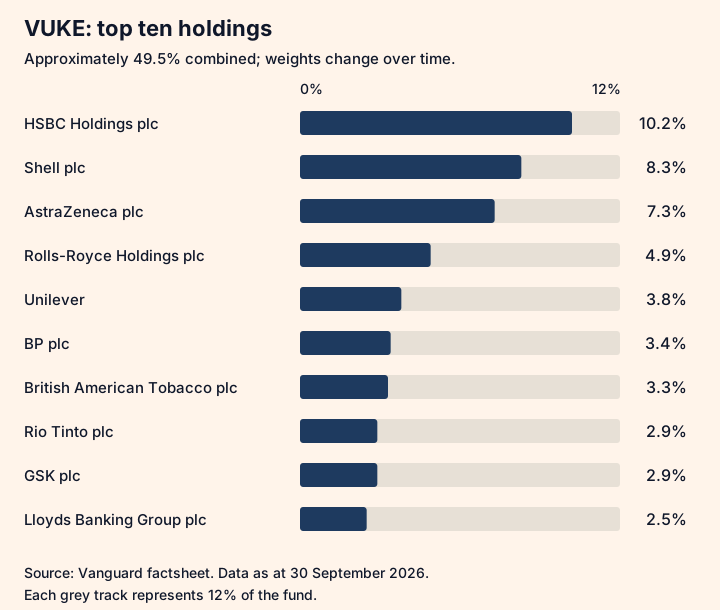 Diagram by Zero To Stocks. Rounded top-ten weights; approximately 49.5% combined. Source: Vanguard factsheet, data as at 30 September 2026.
justETF reports a top-ten total of 49.03% for the same date. That is a separate source's figure, not the total used in the diagram. Both sources show the same ten names.
The count differs by source too. Vanguard lists 104 stocks in the fund against 100 in the benchmark; justETF counts 103 holdings at 30 September 2026. These are the published counts. Do not use one provider's count as if it came from the other.
Sectors and countries
Vanguard's sector breakdown at 30 September 2026 puts Financials at 28.0%, the largest sector, and Technology at 2.3%. It uses ICB, the Industry Classification Benchmark: a system for grouping companies by industry. These weights change over time.
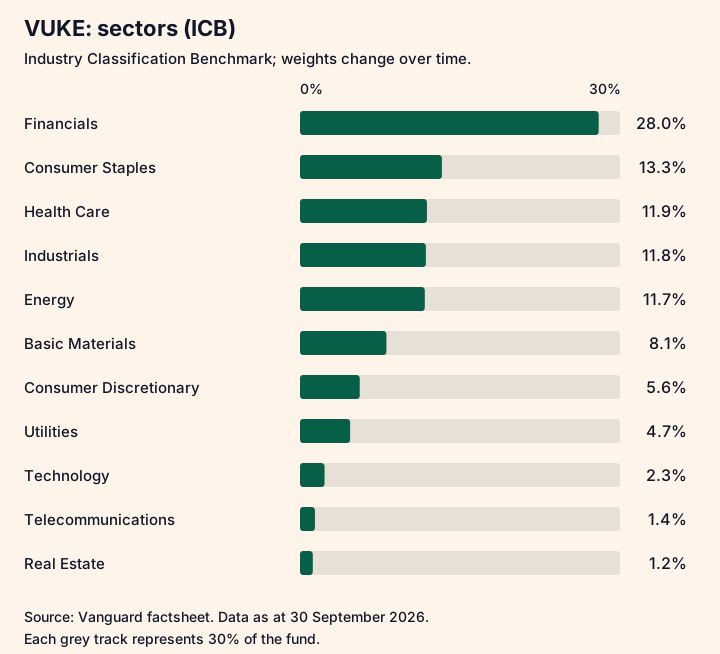 Diagram by Zero To Stocks. All eleven ICB sectors, using Vanguard's rounded weights. Source: Vanguard factsheet, data as at 30 September 2026.
Consumer Staples, Health Care, Industrials and Energy each have much larger weights than Technology in this snapshot. This is a particular mix of industries, rather than an even spread across them.
Country figures also depend on the provider. Vanguard's market allocation at 30 September 2026 is UK 99.8% and Guernsey 0.2%. justETF's country breakdown for that date is UK 94.25%, Switzerland 2.55%, Ireland 1.07% and Other 2.13%. The providers classify the portfolio differently; the figures should not be combined. VUKE follows an index of large UK companies.
For broader country coverage, compare the scope of a developed-world fund such as VHVG. The question is whether you want a UK-focused holding or a fund covering several markets.
VUKE dividends: dates and amounts
Vanguard lists a quarterly dividend schedule. Distributing means the fund pays the dividends out to investors. These are the latest four payments in its distribution history checked for this guide; each amount is in pounds per ETF unit.
| Amount per unit | Ex-dividend date | Payable date |
|---|---|---|
| £0.3968 | 17 September 2026 | 30 September 2026 |
| £0.4532 | 18 June 2026 | 1 July 2026 |
| £0.3620 | 19 March 2026 | 1 April 2026 |
| £0.2297 | 18 December 2025 | 31 December 2025 |
The ex-dividend date is the date from which a purchase no longer carries entitlement to that payment. The payable date is when the fund pays it. They are different dates, as the table shows.
£1.4417 per unit is our sum of the four payments Vanguard lists. The amounts vary by quarter. In the displayed history, ex-dividend dates fall in March, June, September and December. That pattern does not establish the next date or amount. Check Vanguard's distribution history for the next date.
VUKE vs VUKG
VUKE and VUKG are share classes of the same Vanguard FTSE 100 fund. They give you the same underlying portfolio with different treatment of dividends. VUKE pays cash out. Accumulating VUKG keeps the dividends in the fund and reinvests them.
| Detail | VUKE | VUKG |
|---|---|---|
| Dividend policy | Distributing, quarterly | Accumulating |
| ISIN | IE00B810Q511 | IE00BFMXYP42 |
| Inception | 22 May 2012 | 14 May 2019 |
| TER, per justETF | 0.09% a year | 0.09% a year |
| Holdings, per justETF at 30 September 2026 | 103 | 103 |
| Fund size, per justETF checked November 13, 2026 | EUR 5,601m | EUR 2,344m |
Both size figures here come from justETF in euros. They are separate from Vanguard's dated pound figures above.
The practical distinction is cash in hand versus reinvestment inside the fund. The larger share class does not change that choice. For the same dividend-policy question applied to a different index, see VUAG vs VUSA.
Cost: 0.09% a year
Vanguard calls the charge the OCF, or ongoing charges figure. It covers management and ongoing running expenses. justETF uses TER, or total expense ratio, for the yearly running charge. Both list 0.09% for VUKE; justETF lists the same TER for VUKG.
On a constant £10,000 holding, 0.09% is approximately £9 a year. This is an illustration. The charge comes out of fund assets, rather than arriving as a separate annual bill. The pound amount depends on the value held through the year.
Our total expense ratio guide explains the cost terminology. Here, the two share classes have the same stated yearly rate, so that figure does not decide the dividend choice.
VUKE in an ISA and a GIA
An ISA, or Individual Savings Account, is a UK tax wrapper. GOV.UK says dividends within an ISA are not taxed. HMRC's HS265 guidance says income and gains from offshore funds held through an ISA do not need to be declared. The total ISA subscription limit is £20,000 for 2026–27, per GOV.UK.
A GIA, or general investment account, holds investments outside that wrapper. GOV.UK lists a £500 dividend allowance each year: dividend income covered by it is not taxed. Dividend income within any unused Personal Allowance is also not taxed. Above the allowances, rates depend on your Income Tax band.
| Income Tax band | Dividend rate, 6 April 2026 to 5 April 2027 |
|---|---|
| Basic | 10.75% |
| Higher | 35.75% |
| Additional | 39.35% |
justETF lists VUKE and VUKG as UK Reporting. A reporting fund reports its income to HMRC and UK investors. That reportable income is not necessarily the same as the cash paid out.
HS265 says you are taxed on your share of reportable income, including any excess over what was paid out. That difference is excess reported income. It can therefore matter for a distributing holding as well as an accumulating one. HS265 says reporting-fund income, including any excess, should be reported on Self Assessment.
VUKG reinvesting dividends does not remove this GIA tax issue simply because no cash reaches you. Use the fund's income report to establish the relevant amounts. For sales, HS265 says gains on reporting-fund units fall under Capital Gains Tax. GOV.UK lists an annual exempt amount of £3,000 for individuals: the allowance against overall gains, rather than dividends.
Risks
Concentration: Vanguard's top ten hold approximately half the fund at 30 September 2026. This is also a UK-focused index, so it does not spread your investment across world markets.
Industry mix: the same Vanguard snapshot has substantial Financials, Consumer Staples and Energy weights, with little Technology. Those exposures affect what you own, even when the fund holds many shares.
Currency: Vanguard warns that exchange-rate movements can harm an investment. Its general risk wording includes securities denominated in different currencies. A GBP fund currency should not be read as protection from currency risk.
Vanguard also lists liquidity risk, where too few buyers or sellers make investments hard to trade; counterparty risk, where an institution dealing with the fund fails; and index tracking risk, meaning the fund may not follow its index perfectly.
justETF says VUKE uses securities lending, meaning shares are lent to another party. Keep that feature in mind alongside the counterparty warning. Vanguard states that investment values and income can fall, and you may get back less than you invested.
How to choose
- Decide what should happen to dividends. VUKE pays quarterly cash; VUKG reinvests inside the fund.
- Decide the holding's role. Would a UK-focused fund be your whole share portfolio, or an addition to broader holdings? Our VWRP vs VUAG guide explores another coverage choice.
- Consider the account before the share class. Check your ISA position and available allowance; outside it, read the reporting-fund income rules.
- Check the identifier. For the VUKE listing discussed here, match IE00B810Q511, the London exchange and GBP trading line. Then check the current composition on Vanguard or justETF.
If the account and exchange terms are new to you, our guide to starting with ETFs as a European investor explains the wider process.
Limits of this guide
This is general information, not investment or tax advice. The UK tax figures cover 2026–27. Your circumstances affect what you owe. Portfolio composition is dated 30 September 2026 and changes; the dividend table records past payments without predicting future ones.
Sources checked November 13, 2026.
Sources
- S1: justETF — Vanguard FTSE 100 UCITS ETF (GBP) Distributing, VUKE, IE00B810Q511
- S2: Vanguard factsheet VUKE, 30 September 2026 (professional)
- S3: Vanguard UK professional product page VUKE
- S4: justETF — Vanguard FTSE 100 UCITS ETF (GBP) Accumulating, VUKG, IE00BFMXYP42
- S6: GOV.UK — Individual Savings Accounts
- S7: HMRC HS265 Offshore funds
- S8: GOV.UK — Capital Gains Tax allowances
- S9: GOV.UK — Tax on dividends
FAQ
What is VUKE?
VUKE is the London Stock Exchange pound listing of Vanguard FTSE 100 UCITS ETF (GBP) Distributing, ISIN IE00B810Q511. It tracks large UK companies and pays dividends quarterly.
When does VUKE pay dividends?
Vanguard lists a quarterly schedule. Its latest four listed payments ran from December 2025 to September 2026, with ex-dividend dates in December, March, June and September. Check Vanguard's distribution history for the next date; the amounts vary.
What is the difference between VUKE and VUKG?
They are distributing and accumulating share classes of Vanguard's FTSE 100 fund. VUKE pays dividends out; VUKG reinvests them inside the fund. VUKG has ISIN IE00BFMXYP42. justETF lists a 0.09% yearly TER for both.
What does VUKE cost?
Vanguard's factsheet dated 30 September 2026 lists an ongoing charges figure of 0.09% a year. justETF calls this the TER. On a constant £10,000 holding, that is approximately £9 a year, taken from fund assets.
Is VUKE tax-free in an ISA?
GOV.UK says dividends in an ISA are not taxed. HMRC HS265 says income and gains from offshore funds held through an ISA do not need to be declared. The total ISA subscription limit for 2026–27 is £20,000.
Continue reading