ETF Reviews · 01 November 2026 · 9 min read
VWRP vs VUAG: FTSE All-World or S&P 500 for UK Investors (2026)
VWRP holds the whole world in one fund (about 3,800 companies, 0.14% TER, around 60% in the US); VUAG holds the 500 largest US companies at 0.07%. The real choice is spread across countries versus a focus on the US, not which fund is better.
By Marvin
VWRP puts the whole world in one fund. VUAG holds only large American companies. Both are Vanguard ETFs, based in Ireland, accumulating (dividends are reinvested inside the fund, not paid out) and traded in pounds on the London Stock Exchange. So the real question is not which fund is better. It is whether you want the US as the biggest part of your money (about 60% in VWRP) or as nearly all of it (about 97% in VUAG).
This guide is for UK investors choosing between the two, for example in a stocks and shares ISA. Fund facts are as listed on justETF on November 1, 2026. Country, sector and top-10 figures are as of September 30, 2026, per justETF, and they change over time. For the general theory behind accumulating funds, see our guide to accumulating vs distributing ETFs.
VWRP vs VUAG at a glance
| VWRP | VUAG | |
|---|---|---|
| Full name | Vanguard FTSE All-World UCITS ETF (USD) Accumulating | Vanguard S&P 500 UCITS ETF (USD) Accumulating |
| Index | FTSE All-World | S&P 500 |
| What the index covers | Stocks from developed and emerging countries worldwide | The 500 largest US stocks |
| ISIN | IE00BK5BQT80 | IE00BFMXXD54 |
| LSE ticker in GBP | VWRP | VUAG |
| Same share class, other tickers | VWRA (LSE, USD), VWCE (EUR) | VUAA (LSE, USD; Xetra, EUR) |
| TER | 0.14% a year | 0.07% a year |
| Replication | Physical, optimized sampling | Physical, full replication |
| Holdings (justETF count) | 3,797 | 503 |
| Launch date | 23 July 2019 | 14 May 2019 |
| Domicile | Ireland, UCITS | Ireland, UCITS |
| Fund currency | USD, unhedged | USD, unhedged |
| Dividends | Reinvested in the fund | Reinvested in the fund |
| Securities lending | Yes | Yes |
| UK tax status | UK Reporting | UK Reporting |
Some of these terms in plain words:
- UCITS is a set of EU rules for investment funds. justETF lists both funds as UCITS compliant.
- ISIN is the 12-character code that identifies one share class. One share class can trade under several tickers but keeps one ISIN.
- TER (total expense ratio) is the yearly running cost, taken from inside the fund.
- Optimized sampling means the fund buys, in justETF's words, "a selection of the most relevant index constituents" instead of every share in the index. Full replication means it buys all of them.
- Unhedged means the fund does nothing to protect you from currency swings.
- UK Reporting is a UK tax status. We explain what it means in the ISA and GIA section.
What you actually own: countries
As of September 30, 2026, per justETF, 60.33% of VWRP was invested in US companies. Next came Japan (6.04%), Taiwan (3.53%) and the United Kingdom (3.16%). The other 26.94% was spread over the rest of the world. VUAG was 97.34% United States, 1.14% Ireland and 1.52% other.
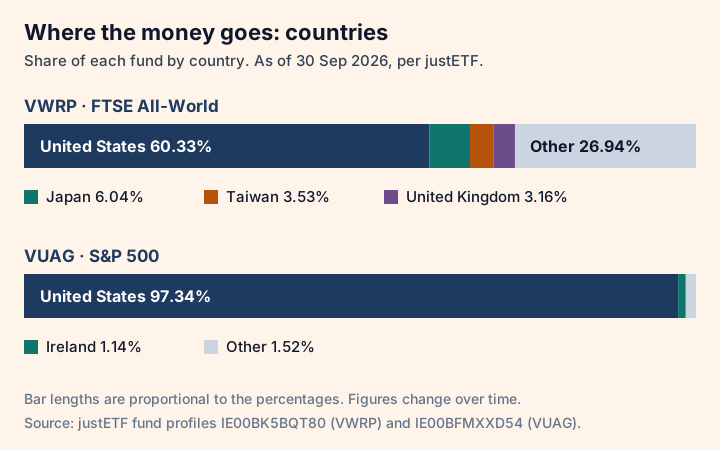 Diagram by Zero To Stocks. Bar lengths are proportional to the percentages. Source: justETF, data as of 30 September 2026.
Two things stand out.
First, VWRP is a world fund, but it is still mostly American. Six in every ten pounds sit in US companies. justETF says the FTSE All-World index "tracks stocks from developed and emerging countries worldwide". So VWRP also holds shares from emerging markets (emerging countries), not only from developed ones. VUAG has none of that spread.
Second, the UK share is small. If you live in the UK and expected a big slice of British companies, VWRP holds 3.16%. justETF's country list for VUAG does not show the UK at all.
justETF lists 1.14% of VUAG under Ireland. The profile does not say which companies that covers, so we will not guess.
Concentration: top 10 and technology
Concentration means how much of a fund depends on a small number of companies or one sector. Here the two funds differ more than the names suggest.
- Top 10 holdings: 24.73% of VWRP (out of 3,797 holdings) and 38.99% of VUAG (out of 503).
- Technology sector: 38.27% of VWRP and 47.59% of VUAG.
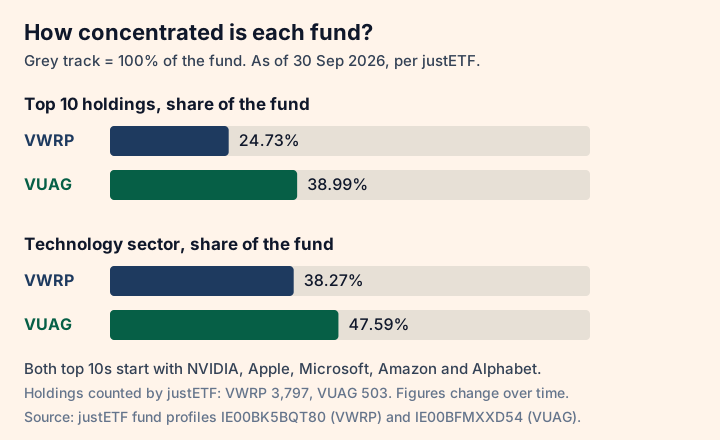 Diagram by Zero To Stocks. Grey track is 100% of each fund. Source: justETF, data as of 30 September 2026.
The biggest names are the same in both funds. Both top-10 lists include NVIDIA, Apple, Microsoft, Amazon, Alphabet, Broadcom, Meta and Micron. (Alphabet appears twice, as class A and class C shares: two types of share in the same company.) VWRP's list adds Taiwan Semiconductor Manufacturing; VUAG's adds Tesla.
The difference is the weight. NVIDIA is 8.37% of VUAG and 5.01% of VWRP. Apple is 7.36% versus 4.52%. In VUAG, more of your money rides on a handful of large US technology companies. In VWRP, the same companies sit at the top, but with smaller slices and with thousands of other companies around them.
Cost: 0.14% vs 0.07%
justETF lists a TER of 0.14% a year for VWRP and 0.07% for VUAG. You never get a bill for this. justETF says the costs are "withdrawn continuously from the fund assets and already included in the performance of the ETF." Our TER guide explains how that works.
A simple illustration: if you hold £10,000 for a year, 0.14% is about £14 and 0.07% is about £7. The difference is roughly £7 a year per £10,000. The real amount moves with the value of your holding during the year.
£7 a year on £10,000 is small next to the main decision. Choosing between the whole world and only the US changes what you own. Choosing on cost alone changes very little.
The two funds also copy their index differently. VUAG uses full replication: it buys all the shares in the S&P 500. VWRP uses optimized sampling: it holds a selection of the most relevant shares in its index. So VWRP does not necessarily hold every company in its index.
Same family, different tickers
VWRP is the London pound listing of the same share class that trades as VWRA in US dollars and as VWCE in euros. Our VWCE review untangles that ticker maze. VUAG is the pound listing of the share class that trades as VUAA, and its distributing sister share class is VUSA, which pays dividends out instead of reinvesting them. The VUAG vs VUSA guide covers that choice. Whatever you buy, check the ISIN: IE00BK5BQT80 for VWRP, IE00BFMXXD54 for VUAG.
VWRP vs VUAG in an ISA and a GIA
An ISA (Individual Savings Account) is a UK account where you can save and invest tax-free. GOV.UK says that in the 2026–27 tax year you can put up to £20,000 into ISAs in total. A stocks and shares ISA is the type that holds funds like these.
Both funds are based in Ireland and carry "UK Reporting" status, which comes from the UK tax rules for offshore funds (broadly, investment funds based outside the UK). HMRC's helpsheet HS265 says that if you hold an offshore fund through an ISA, "you do not need to declare the income or gains from these funds." That applies equally to VWRP and VUAG.
A GIA (general investment account) is a normal investment account with no tax wrapper. Here the "UK Reporting" status matters.
A reporting fund is a non-UK fund that HMRC has approved. It reports its income to HMRC and to UK investors. HS265 says UK investors are taxed on their full share of that reportable income, "even if it has not been distributed." The part you did not receive in cash is called excess reported income. Both VWRP and VUAG reinvest their dividends, so this applies to both in the same way.
The fund gives its reportable income as an amount per share for each reporting period. You multiply that amount by the number of shares you held at the end of the reporting period. HS265 says this income counts as received on the "fund distribution date". That is 6 months after the end of the reporting period. This date decides the tax year for your Self Assessment return. For the full calculation, see HS265 and our VUAG vs VUSA guide.
When you sell in a GIA, Capital Gains Tax can apply. GOV.UK says you only pay it on your overall gains above the Annual Exempt Amount of £3,000.
The short version: tax does not separate these two funds. Inside an ISA you declare nothing for either. In a GIA, both follow the same reporting-fund rules. The step-by-step GIA paperwork for an accumulating Vanguard fund is in our VUAG vs VUSA guide. This guide does not cover pensions such as a SIPP.
Risks each fund carries
VUAG:
- One country. About 97% is in US companies. If US shares fall, there is little else in the fund to soften the drop.
- Higher concentration. The top 10 make up 38.99% of the fund and technology 47.59%, as of September 30, 2026.
VWRP:
- Still mostly US. About 60% is in US companies, so a fall in US shares still hits most of the fund.
- Emerging markets. Its index tracks stocks from developed and emerging countries, so part of the fund is in emerging markets.
- Sampling. It holds "a selection of the most relevant index constituents", not every share in its index.
Both:
- Currency. Both funds are unhedged: the fund currency is USD and many holdings are priced in other currencies than the pound. Currency movements can affect their value in pounds.
- Securities lending. justETF lists securities lending as "Yes" for both funds. This means the fund lends some of its shares to other parties. Check the fund's documents if you want to know how this works.
- Prices go down as well as up. You can get back less than you put in.
Can you hold both?
You can. But know what you are doing. The same big US names sit at the top of both funds' top-10 lists. VWRP uses optimized sampling, so it does not necessarily hold every company in its index. What adding VUAG clearly does is raise your US weight above the roughly 60% that VWRP already has, and put extra weight on the same big technology names.
That can be a deliberate choice. It can also happen by accident, if you buy both without checking what is inside. If you combine them, pick the extra US share on purpose and write it down. We do not suggest a percentage. Our three-fund portfolio guide shows how people build a mix from separate funds.
What about VWRP vs VUAG performance?
You can see each fund's past returns on its justETF page or at your broker. They will differ by period, because one fund is US-only and the other is global. But past returns do not predict future returns. A fund that did better over one stretch can do worse over the next. Choosing between these two because of a recent chart means betting that the recent pattern will continue. We do not show return figures here, because they change daily and say nothing certain about the future.
How to choose between VWRP and VUAG
- Decide what you want to own. One fund for the whole world, US included: VWRP. Only large US companies, on purpose: VUAG.
- Check whether you can live with concentration. In VUAG, more of your money depends on a few large tech companies and on one country.
- Keep cost in proportion. The gap is 0.07 percentage points a year, about £7 per £10,000. It rarely decides this choice.
- Compare the account rules. Inside a stocks and shares ISA you do not declare income or gains from these funds. Outside it, in a GIA, the reporting-fund rules above apply to both.
- Check the ISIN, the pound listing and the current fund page. IE00BK5BQT80 for VWRP, IE00BFMXXD54 for VUAG. Fees and holdings change, so check the TER and the country split before you buy.
New to ETFs? Start with our guide to investing in ETFs.
If you want Vanguard's developed-markets-only accumulating fund, see our VHVG review.
Limits of this guide
This guide compares two funds. It is not financial advice, not tax advice and not a recommendation to buy either fund. The tax rules described are the UK rules for the 2026–27 tax year, simplified; your own situation may differ, so ask HMRC or a qualified adviser if you are unsure. Country, sector and top-10 figures are as of September 30, 2026, per justETF, and fund data such as fees and listings can change. Sources checked November 1, 2026.
Sources
FAQ
Is VWRP or VUAG better?
Neither is better in general. They answer different questions. VWRP spreads your money over developed and emerging countries; VUAG holds only large US companies. VUAG is cheaper (0.07% vs 0.14% TER, as listed on justETF on November 1, 2026) and more concentrated. Which one fits depends on how much of your money you want to depend on one country. This is general information, not personal advice.
How much of VWRP is in US stocks?
justETF lists 60.33% in the United States as of September 30, 2026. Next come Japan (6.04%), Taiwan (3.53%) and the United Kingdom (3.16%). The rest, 26.94%, is spread over other countries. These weights change over time.
Is VWRP the same as VWCE?
Yes, it is the same share class with the same ISIN, IE00BK5BQT80. VWRP is the London Stock Exchange listing in pounds, VWRA is the London listing in US dollars and VWCE is the euro listing on exchanges such as Xetra and Euronext Amsterdam. Same fund, different trading currency.
Can I hold VWRP and VUAG together?
You can. The same big US names sit at the top of both funds' top-10 lists. Adding VUAG raises your US share above the roughly 60% that VWRP already has. If you do it, decide on purpose how much extra US weight you want. We do not suggest a split.
Which is cheaper, VWRP or VUAG?
VUAG. justETF lists a TER of 0.07% a year for VUAG and 0.14% for VWRP. As a simple illustration, on £10,000 that is roughly £7 a year versus £14. The cost is taken from the fund's assets, not billed to you separately.
Continue reading