ETF Reviews · 08 November 2026 · 9 min read
VHVG Review (2026): Vanguard FTSE Developed World UCITS ETF
VHVG is Vanguard's accumulating developed-world ETF: the LSE pound listing of IE00BK5BQV03, with a 0.12% TER and no emerging markets. VWRP adds emerging markets at 0.14%, as listed on justETF on 8 November 2026.
By Marvin
VHVG is Vanguard's accumulating FTSE Developed World UCITS ETF: the pound listing on the London Stock Exchange, with the same share class as VHVE and ISIN IE00BK5BQV03. It holds large and mid-sized companies in developed markets, without the emerging-market slice included in VWRP. justETF lists a yearly TER of 0.12% for VHVG versus 0.14% for VWRP on 8 November 2026.
Accumulating means dividends are reinvested inside the fund. Our accumulating vs distributing ETF guide explains that choice. Here, the main question is which countries you want to own through a single fund.
What VHVG is
These fund facts are as listed on justETF and Vanguard on 8 November 2026. The holdings count has its own date below.
| Fund fact | VHVG |
|---|---|
| Full name | Vanguard FTSE Developed World UCITS ETF (USD) Accumulating |
| Index | FTSE Developed: large and mid-sized companies in developed markets |
| ISIN | IE00BK5BQV03 |
| London pound ticker | VHVG |
| Other listings of this share class | VHVE (London, USD); VGVF (Xetra, EUR) |
| TER | 0.12% a year |
| Replication | Physical, optimized sampling / representative sample |
| Holdings | Vanguard: 1,910 at 30 September 2026 |
| Share class launch | 24 September 2019; listed 26 September 2019, per Vanguard |
| Domicile and structure | Ireland, UCITS |
| Fund currency | USD, unhedged |
| Dividends | Accumulating |
| Securities lending | Yes, per justETF |
| UK tax status | UK Reporting |
An ETF is an investment fund traded on an exchange. FTSE Developed is the index, or list of shares, that this fund aims to follow. Developed markets are the countries covered by that index; emerging markets are a separate group covered by VWRP's broader index.
UCITS refers to EU rules for investment funds. An ISIN identifies the share class across exchanges. Physical sampling means buying a selection of actual shares from the index. Unhedged means the fund does not protect you from currency movements. UK Reporting is a tax status, explained below.
justETF counts 1,906 holdings for the same 30 September 2026 snapshot, while Vanguard reports 1,910. Use the named source when comparing counts; do not treat the two numbers as interchangeable.
What you actually own: countries
Vanguard's country tables at 30 September 2026 put the US at 69.16% of VHVG, versus 62.24% of VWRP. Without the emerging-market slice, VHVG has more weight in the US. These weights change over time.
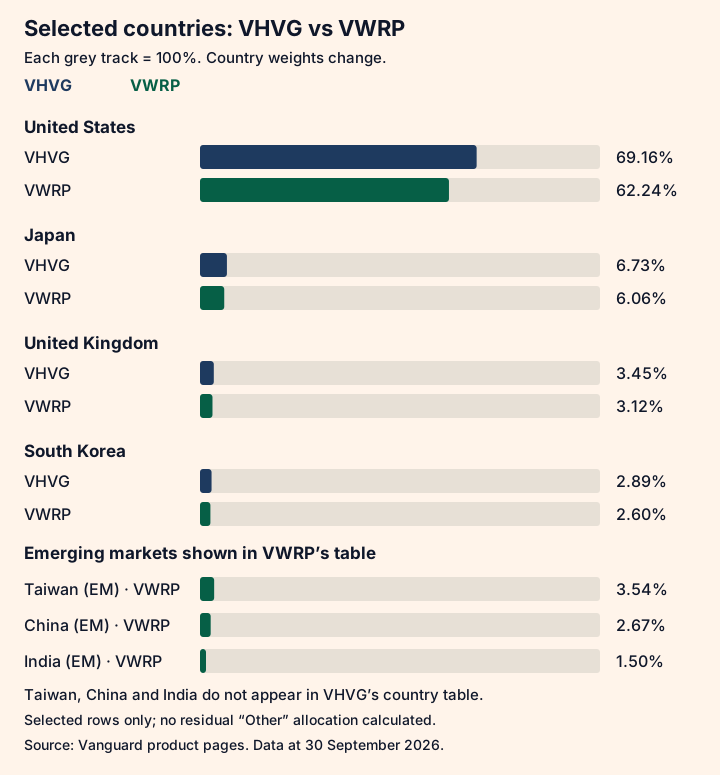 Diagram by Zero To Stocks. Selected countries, not a complete allocation; each bar uses the same scale. Source: Vanguard, data as of 30 September 2026.
Japan accounts for 6.73% of VHVG and 6.06% of VWRP. The UK is only 3.45% and 3.12%, respectively. A pound trading line does not mean a large holding in British companies.
For a fund that holds mostly large British companies, see our VUKE review.
Vanguard labels Taiwan (3.54%), China (2.67%) and India (1.50%) as emerging markets in its VWRP table. Those three names do not appear in the VHVG table. South Korea appears in both: 2.89% in VHVG and 2.60% in VWRP.
The diagram shows selected countries rather than forcing every allocation into a full bar. Vanguard's published VHVG country rows do not add up to 100%; its note allows for rounding and omitted cash or derivative instruments. We have not invented an extra country category to fill the gap.
Concentration: top 10 and sectors
Concentration means how much of a fund sits in a small group of companies or in one industry. justETF's data as of 30 September 2026 gives VHVG a top-10 weight of 26.43%, versus 24.73% for VWRP. These figures change.
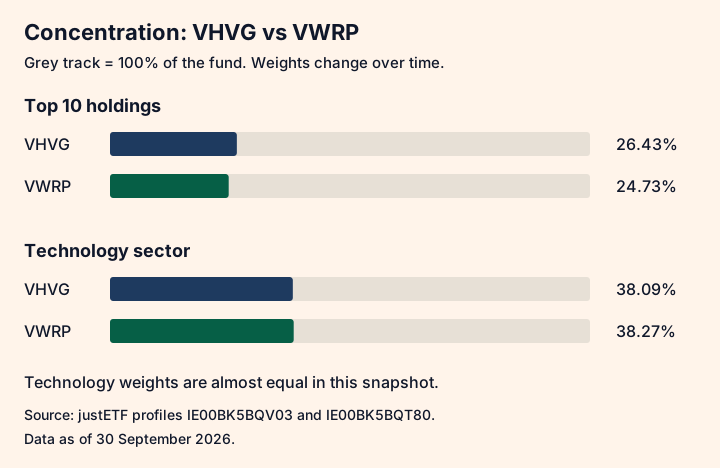 Diagram by Zero To Stocks. Grey tracks represent 100% of each fund. Source: justETF, data as of 30 September 2026.
Technology is almost equal: 38.09% in VHVG and 38.27% in VWRP. Leaving out emerging markets barely changes that sector weight in this snapshot. A developed-only label does not mean less technology.
| Sector, per justETF at 30 September 2026 | VHVG | VWRP |
|---|---|---|
| Technology | 38.09% | 38.27% |
| Finance | 17.24% | 17.87% |
| Industrials | 9.26% | 8.98% |
| Healthcare | 8.50% | 8.04% |
| Other | 26.91% | 26.84% |
Vanguard's VHVG product-page top-10 rows at 30 September 2026 are NVIDIA, Apple, Microsoft, Amazon, Alphabet, Broadcom, Alphabet again, Meta, Micron and Tesla. Alphabet occupies two separate rows. This is the product-page list, not the differently grouped factsheet list.
VWRP's product-page list has the same large US technology names near the top and also includes Taiwan Semiconductor Manufacturing (TSMC). TSMC does not appear in VHVG's product-page top 10. These lists show common holdings, but they do not establish a percentage overlap between the funds.
Cost: 0.12% a year
TER, the total expense ratio, is the yearly running cost taken from the fund's assets. justETF lists 0.12% for VHVG and 0.14% for VWRP on 8 November 2026. Our TER guide explains the charge.
On a constant £10,000 holding, those rates mean roughly £12 and £14 a year. That is an illustration, not a separate annual bill. The actual amount depends on the value of your holding through the year.
The small cost gap sits alongside a larger choice about coverage. VHVG leaves emerging markets out; VWRP includes them.
justETF calls VHVG's method optimized sampling. Vanguard calls it a representative sample: the fund buys a selection of shares to follow the index, rather than needing to own every constituent. Physical means it holds actual securities.
The same fund, different tickers
VHVG and VHVE can look like two choices on a broker's search screen. On the London Stock Exchange, VHVG trades in pounds and VHVE in US dollars. Both identify the same accumulating share class, IE00BK5BQV03. VGVF is its euro listing on Xetra, per Vanguard and justETF on 8 November 2026.
The trading currency does not change the underlying portfolio or remove currency risk.
VEVE is different. It is the London pound listing of the distributing share class, ISIN IE00BKX55T58. Distributing means dividends are paid out. justETF lists quarterly payments and a launch date of 30 September 2014, compared with 24 September 2019 for the accumulating share class.
Check the ISIN as well as the ticker. If you want dividends kept inside this developed-world fund, the accumulating share class is the one described here.
VHVG vs VWRP
The central choice is developed markets only, or developed plus emerging markets in one fund. Vanguard says FTSE Developed covers large and mid-sized companies in developed markets. FTSE All-World adds emerging markets.
| Main difference | VHVG | VWRP |
|---|---|---|
| Index | FTSE Developed | FTSE All-World |
| US weight, Vanguard at 30 September 2026 | 69.16% | 62.24% |
| Stocks, Vanguard at 30 September 2026 | 1,910 | 3,821 |
| TER, justETF on 8 November 2026 | 0.12% | 0.14% |
Both are Vanguard accumulating funds based in Ireland. Both have UK Reporting status and use physical sampling, per Vanguard and justETF. Those features do not settle the coverage choice.
VWRP's country table includes Taiwan, China and India as emerging markets. That makes it the broader option by market coverage. VHVG fits a decision to hold developed markets through this fund, leaving any emerging-market allocation as a separate decision. Neither approach is a recommendation here.
VWRP's other tickers, VWRA and VWCE, are covered in our VWCE review. For a VHVG vs VWRP performance chart, use Vanguard, justETF or your broker and check the period shown. Past performance is not a reliable guide to future results.
How VHVG compares with IWDA and VUAG
IWDA is iShares' MSCI World ETF. It uses another provider and index family. Our IWDA review covers that fund; its figures should not be used as a substitute for VHVG's own data.
VUAG is Vanguard's S&P 500 ETF. Comparing VHVG with VUAG raises a different question: a developed-world portfolio versus a US-focused index. Our VWRP vs VUAG guide explains the world-versus-US choice.
VHVG in an ISA and a GIA
An ISA, or Individual Savings Account, is a UK tax-free saving and investing account. GOV.UK gives a total ISA contribution limit of £20,000 for 2026–27. A stocks and shares ISA is the investment version.
HMRC's HS265 says income and gains from offshore funds held through an ISA do not need to be declared. That applies to the funds discussed here in the same way.
A GIA, or general investment account, has no ISA tax wrapper. VHVG and VWRP are both accumulating and UK Reporting. A reporting fund is a non-UK fund approved by HMRC that reports income to HMRC and investors.
HS265 says UK investors are taxed on their share of reportable income even when it is not paid out. Excess reported income is the part of that income above the cash distributed. Reinvesting dividends does not make this disappear. Use the fund's income report when working out what to declare; the accumulating vs distributing guide covers the general GIA explanation.
Selling in a GIA can also create a capital gain. GOV.UK gives an Annual Exempt Amount, the tax-free allowance for overall gains, of £3,000. These account rules do not create a tax distinction between VHVG and VWRP simply because one includes emerging markets. Your own tax position still matters.
Risks
- Developed markets only. VHVG omits the emerging-market coverage included in VWRP. Decide whether that matches the portfolio you intend to hold.
- US concentration. Vanguard puts 69.16% in the US at 30 September 2026. Many holdings do not mean an even split between countries.
- Sampling. A selected portfolio may not follow its index exactly. Vanguard's factsheet identifies index-tracking risk.
- Currency. The fund currency is USD and the portfolio spans other developed-market currencies. It is unhedged. Currency moves can affect its value in pounds, even when you buy VHVG in GBP.
- Securities lending. justETF lists this as enabled. It means lending securities to other parties. Vanguard's factsheet also flags counterparty risk: the risk that another party fails to meet its obligations.
- Falling share values. Vanguard warns that investments can fall and you may get back less than you invested.
How to choose
- Decide on emerging markets. Do you want them inside the same fund? VWRP includes them; VHVG does not.
- Check the US weight. VHVG's developed-only coverage comes with a higher US share in this snapshot.
- Put the fee gap in context. The illustration is about £12 versus £14 annually per £10,000. Coverage changes what you own.
- Check the account first. Understand the ISA rules and allowance before comparing holdings in a GIA. The same reporting-fund rules apply to both outside an ISA.
- Check the listing and current documents. For VHVG, match ISIN IE00BK5BQV03 with the London GBP line. Recheck the TER and composition on Vanguard or justETF.
For the practical first steps, see our guide to investing in ETFs.
Limits of this guide
This is general information, not investment or tax advice. UK tax rules refer to 2026–27 and are simplified. Country, sector and top-10 data are dated 30 September 2026 and change over time. Fund facts such as costs and listings are as checked on 8 November 2026. Sources checked November 8, 2026.
Sources
- S1: justETF — Vanguard FTSE Developed World UCITS ETF Acc, IE00BK5BQV03
- S2: Vanguard — FTSE Developed World accumulating factsheet, 30 September 2026
- S3: Vanguard UK — FTSE Developed World UCITS ETF (USD) Accumulating (VHVG)
- S4: justETF — Vanguard FTSE All-World UCITS ETF Acc, IE00BK5BQT80
- S5: Vanguard UK — FTSE All-World UCITS ETF (USD) Accumulating (VWRP)
- S6: GOV.UK — Individual Savings Accounts
- S7: HMRC — HS265 Offshore funds
- S8: GOV.UK — Capital Gains Tax allowances
- S9: justETF — Vanguard FTSE Developed World UCITS ETF Distributing, IE00BKX55T58
FAQ
What is VHVG?
VHVG is the London Stock Exchange pound listing of Vanguard FTSE Developed World UCITS ETF (USD) Accumulating, ISIN IE00BK5BQV03. It tracks large and mid-sized companies in developed markets and reinvests dividends.
Is VHVG the same as VHVE or VEVE?
VHVG and the LSE dollar listing VHVE are the same accumulating share class, ISIN IE00BK5BQV03. VEVE is the LSE pound listing of the distributing share class, ISIN IE00BKX55T58, which pays dividends quarterly, per justETF.
Does VHVG include emerging markets?
No. Its FTSE Developed index covers developed markets. VWRP's FTSE All-World index includes developed and emerging markets. Vanguard's VWRP country table at 30 September 2026 includes Taiwan, China and India as emerging markets; those names do not appear in its VHVG table.
VHVG or VWRP for an ISA?
The main choice is coverage: developed markets only with VHVG, or developed and emerging markets together with VWRP. Both are accumulating and UK Reporting. HMRC says income and gains from offshore funds held through an ISA do not need to be declared. This is general information, not a recommendation.
What does VHVG cost?
justETF lists a TER of 0.12% a year for VHVG on 8 November 2026, versus 0.14% for VWRP. On a constant £10,000 holding, that is roughly £12 versus £14 annually. TER is taken from fund assets.
Continue reading