ETF Reviews · 25 October 2026 · 9 min read
VUAG vs VUSA: Vanguard S&P 500 UCITS ETF Compared (2026)
VUAG and VUSA are two share classes of the same Vanguard S&P 500 UCITS ETF: same index, same 0.07% TER. VUAG reinvests the dividends inside the fund; VUSA pays them out every quarter.
By Marvin
For UK investors, where you hold the fund matters more than which version you pick. In a stocks and shares ISA the difference is mostly a matter of taste. In a general investment account (GIA), both follow the same tax rules, but the paperwork differs. This guide sticks to this one fund. For the general theory, see our guide to accumulating vs distributing ETFs.
All fund facts below are as listed on justETF on October 25, 2026.
VUAG and VUSA at a glance
A share class is one version of a fund. The fund owns one pot of shares, and each class gives you a slice of that pot with its own rules, such as what happens to dividends. Each share class has its own ISIN, the 12-character code that identifies it worldwide.
| VUAG (accumulating) | VUSA (distributing) | |
|---|---|---|
| ISIN | IE00BFMXXD54 | IE00B3XXRP09 |
| Dividends | Reinvested in the fund | Paid out quarterly |
| Launch date | 14 May 2019 | 22 May 2012 |
| TER | 0.07% a year | 0.07% a year |
| Index | S&P 500 | S&P 500 |
| Replication | Physical, full replication | Physical, full replication |
| Holdings (justETF count) | 503 | 503 |
| Domicile | Ireland, UCITS | Ireland, UCITS |
| Fund currency | USD, unhedged | USD, unhedged |
| Securities lending | Yes | Yes |
| UK tax status | UK Reporting | UK Reporting |
| LSE ticker in GBP | VUAG | VUSA |
| LSE ticker in USD | VUAA | VUSD |
A few of these terms in plain words. UCITS is the EU rulebook for funds sold to ordinary investors. TER (total expense ratio) is the yearly running cost; justETF says it is "withdrawn continuously from the fund assets and already included" in the performance, so you never get a separate bill. Our TER guide explains this in more depth. Full replication means the fund buys all the shares in the index. Unhedged means the fund does nothing to protect you from currency swings. UK Reporting is the UK tax status justETF shows for both classes; we explain what it means in the GIA section below.
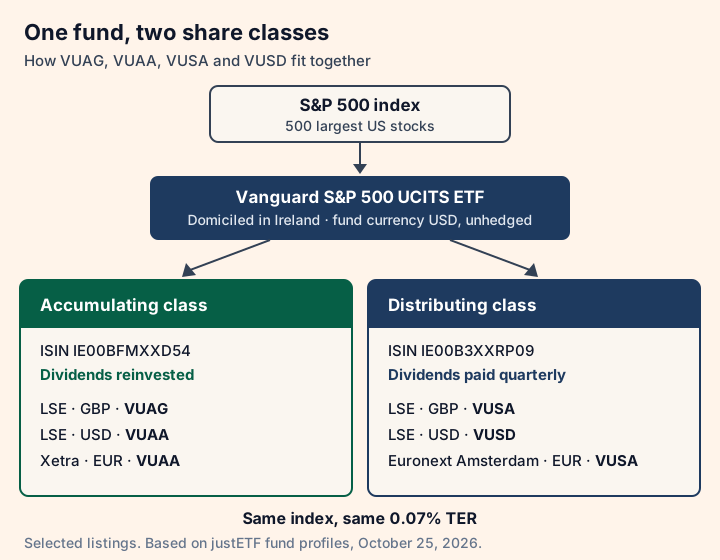 Diagram by Zero To Stocks. Same index, same 0.07% TER; selected listings only. Source: justETF fund profiles IE00BFMXXD54 and IE00B3XXRP09, October 25, 2026.
VUAG, VUAA, VUSA, VUSD: why there are four tickers
There are two share classes, but each one trades on several stock exchanges in different currencies. Every listing gets its own ticker (the short trading code). That is where the confusion comes from.
- VUAG and VUAA are the same accumulating class (ISIN IE00BFMXXD54). On the London Stock Exchange, VUAG trades in pounds and VUAA in US dollars. On Xetra in Germany it trades in euros as VUAA.
- VUSA and VUSD are the same distributing class (ISIN IE00B3XXRP09). On the London Stock Exchange, VUSA trades in pounds and VUSD in US dollars. On Euronext Amsterdam and Euronext Paris, the euro line is also called VUSA.
So "VUSA" can mean a pound listing in London or a euro listing in Amsterdam. Same share class, different currency. If you want to trade in pounds on the LSE, the tickers are VUAG and VUSA.
The trading currency does not change what the fund owns. Whether you buy VUAG in pounds or VUAA in dollars, you get a slice of the same US shares. The currency only affects how you pay and how the price is shown. Because tickers repeat across exchanges, always check the ISIN at your broker before you buy.
The one real difference: what happens to the dividends
Many companies in the S&P 500 pay dividends: a share of their profit, paid in cash to shareholders. The fund collects those dividends. What it does next depends on the share class.
- VUAG (accumulating): justETF says dividends "are reinvested in the fund on the ex-date, which leads to an increase of the ETF's share price." You receive no cash. Each share you own simply becomes worth a little more.
- VUSA (distributing): the dividends are paid out to investors. justETF lists the frequency as quarterly. The cash lands in your broker account, and you decide whether to spend it or buy more shares.
In practice: with VUAG your number of shares stays the same and the price carries the dividend. With VUSA you see cash payments on your statement four times a year. If you reinvest them yourself, you end up with more shares.
Vanguard's UK large-company fund comes in the same two versions; see our VUKE review.
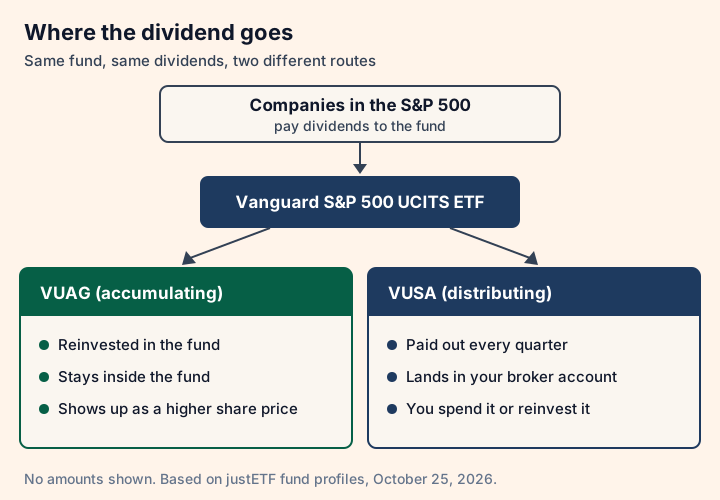 Diagram by Zero To Stocks. No amounts shown. Source: justETF fund profiles IE00BFMXXD54 and IE00B3XXRP09, October 25, 2026.
Is VUAG the S&P 500?
VUAG is not the index itself. It is a fund that tries to copy it. justETF says the fund "seeks to track the S&P 500® index" and describes that index as tracking "the 500 largest US stocks". VUSA follows exactly the same index.
justETF counts 503 holdings for both classes. The name "S&P 500" is a label for the index, not an exact count of positions, so the number of holdings can be a little above 500. Both classes use full replication: the fund buys every share in the index rather than a sample.
One thing the S&P 500 is not: the whole US stock market. It covers large US companies only. If you want small and mid-sized US companies too, an S&P 500 fund does not give you that.
VUAG vs VUSA in a stocks and shares ISA
An ISA (Individual Savings Account) is a UK account in which you can save and invest tax-free. GOV.UK says that in the 2026–27 tax year you can put up to £20,000 into ISAs in total. You must be 18 or over and, in most cases, resident in the UK. A stocks and shares ISA is the type that holds funds like these.
Inside an ISA, the tax difference between VUAG and VUSA disappears:
- GOV.UK: "You do not pay tax on dividends from shares in an ISA."
- HMRC's helpsheet HS265: if you hold an offshore fund through an ISA, "you do not need to declare the income or gains from these funds." (VUAG and VUSA are Irish funds with "UK Reporting" status, which comes from the UK tax rules for offshore funds.)
So in an ISA the question is simply what you want the dividends to do. Do you want cash every quarter, for example to spend? Then VUSA fits. Do you want the dividends reinvested without doing anything? Then VUAG fits. Neither is better on cost: both charge 0.07%.
If you hold either fund in a pension account such as a SIPP, check your provider's information and the pension rules. This guide does not cover pension tax.
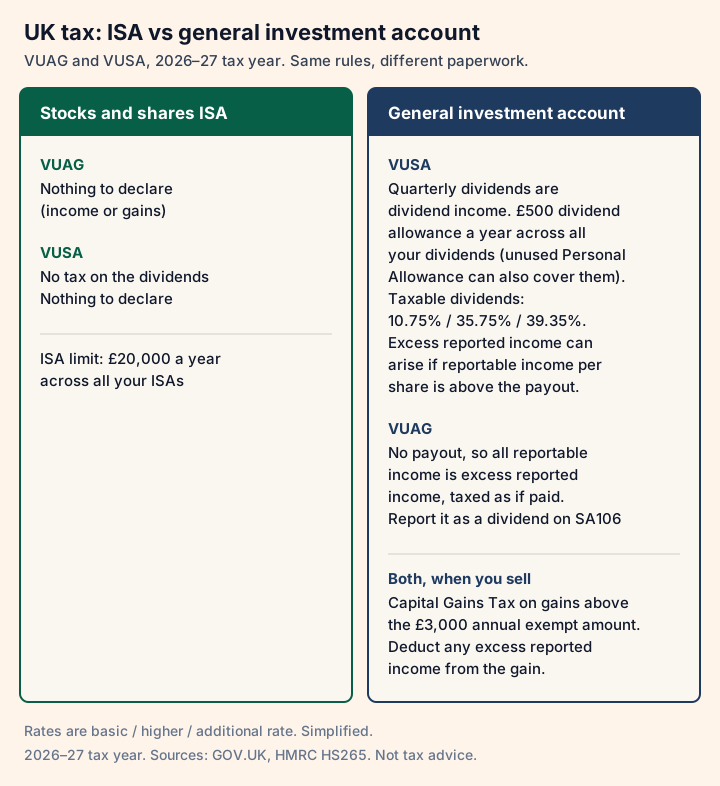 Diagram by Zero To Stocks. 2026–27 tax year, simplified. Sources: GOV.UK tax on dividends, ISAs and CGT allowances; HMRC HS265. Not tax advice.
VUAG vs VUSA in a general investment account (GIA)
A GIA is a normal investment account with no tax wrapper. justETF lists both classes as "UK Reporting", so the same reporting-fund rules from HMRC's HS265 apply to both: same rules, different paperwork. What differs is whether the income is paid out to you, when it counts as received, and how much record-keeping that takes.
VUSA: quarterly dividends. The payouts count as dividend income. GOV.UK says dividends that fall within your Personal Allowance are not taxed, and you also get a dividend allowance of £500 a year for all your dividends combined, not per fund. Above that, the rates from 6 April 2026 to 5 April 2027 are 10.75% (basic rate), 35.75% (higher rate) and 39.35% (additional rate). If your dividends go over your unused Personal Allowance and the dividend allowance, you need to report them to HMRC.
VUAG: taxed on income you never received. This is the part that surprises people. justETF lists VUAG as "UK Reporting", which means it is a reporting fund: a non-UK fund that HMRC has approved and that reports its income to HMRC and to UK investors every period. HS265 explains what follows:
- The fund publishes its reportable income as an amount per share. You multiply it by the number of shares you held at the end of the reporting period.
- UK investors are taxed on their full share of that income "even if it has not been distributed". The part you did not receive in cash is called excess reported income. With VUAG, which pays nothing out, that is all of it.
- Excess reported income is treated as received on the fund distribution date, which is 6 months after the reporting period ends. HMRC's example: a period ending 31 July 2024 has a fund distribution date of 31 January 2025, so it goes on the 2024–25 return.
- For a fund that is a company and not a "bond fund" (a fund with more than 60% in interest-bearing assets), HS265 says to report the income as a dividend. It goes on the foreign pages of your Self Assessment return (SA106), under "Dividends from foreign companies". justETF lists this fund as an open-ended investment company holding US shares; if you are unsure which category applies, HS265 says to ask the fund manager.
- The fund provides a report (often a PDF or a web page) with the figures you need. If it has not arrived by the time you file, HS265 says to use your best estimate and amend later if needed.
VUSA can have excess reported income too. The same rules apply: if its reportable income per share is higher than what it paid out, the difference is excess reported income, taxed in the same way. HS265 also treats each share class as a separate offshore fund. So a VUSA holder should also check the fund report for their class every year.
When you sell. Both classes fall under Capital Gains Tax (CGT), the tax on profit when you sell. GOV.UK says you only pay it on your overall gains above the Annual Exempt Amount of £3,000. For both classes, HS265 lets you deduct any excess reported income from the gain, so you are not taxed twice on the same money. That only works if you have kept a record of it each year.
The honest summary: the rules are the same, the paperwork is not. In a GIA, VUSA is easier to follow, because its payouts show up on your statements; you still check the fund report for any excess. With VUAG, all of the reportable income is excess reported income, so you have to look up the fund's report every year and keep your own records. That is not a reason to call one better, but it is real work. If you are unsure how this applies to you, ask HMRC or a tax adviser.
Is VUAG the same as VOO?
No. VUAG is an Irish-domiciled UCITS fund with its own ISIN (IE00BFMXXD54). That share class trades as VUAG in pounds on the London Stock Exchange, and as VUAA on the LSE in dollars and on other European exchanges. If you are looking at an ETF listed on a US exchange, that is a different fund with its own rules.
It matters in practice because Robinhood UK says investors in the UK and EU have not been able to buy US-listed ETFs since 2018. The reason it gives: PRIIPs rules require providers to give retail investors documents such as a Key Information Document (KID), and ETFs listed in US markets do not provide them. That is Robinhood UK's explanation for its own platform; check what your broker offers.
VUAG vs CSPX and SXR8
CSPX and SXR8 are tickers for a different fund that tracks the same index: the iShares Core S&P 500 UCITS ETF USD (Acc), ISIN IE00B5BMR087. justETF lists it at a 0.07% TER, the same as VUAG. Like VUAG, it is accumulating and uses full replication. On the London Stock Exchange it trades as CSPX in US dollars and CSP1 in pence (GBX). SXR8 is its euro listing on Xetra. Our SXR8 review covers that fund in detail.
So VUAG vs CSPX is mostly a choice of fund provider, Vanguard or iShares, for the same index.
These are not the only S&P 500 UCITS options either. justETF's list of S&P 500 funds on the VUAG page includes an Invesco S&P 500 UCITS ETF Acc at 0.05% and a State Street SPDR S&P 500 UCITS ETF (Dist) at 0.03%. The Invesco fund is swap-based: instead of holding all the index shares, it gets the index return through a contract with a bank, called a swap. We do not compare or rank these funds here.
Risks VUAG and VUSA share
Choosing between the two classes does not change the risks. They own the same shares.
- One country, large companies only. The fund holds large US companies. If US shares fall, there is nothing else in it to soften the drop.
- Dollar risk. The fund currency is USD and the fund is unhedged. Even if you buy VUAG or VUSA in pounds, you own US shares priced in dollars. If the dollar falls against the pound, your holding loses value in pounds, even if US share prices do not move.
- Securities lending. justETF lists securities lending as "Yes" for both classes. This means the fund lends some of its shares to other market players for a fee. It brings in extra income, but adds the risk that a borrower does not give the shares back.
- Prices go down as well as up. An index fund follows the market in both directions. You can get back less than you put in.
If you want a broader spread than one country, our reviews of IWDA and VWCE cover world funds, and the three-fund portfolio guide shows how people combine funds.
For a side-by-side of VUAG and Vanguard's world fund, see VWRP vs VUAG.
How to choose between VUAG and VUSA
- Start with the account. In a stocks and shares ISA, tax does not separate the two. In a GIA, both follow the same tax rules, but the paperwork differs.
- Decide what the dividends should do. Cash every quarter: VUSA. Reinvested automatically: VUAG.
- Be honest about paperwork. In a GIA, VUAG means looking up excess reported income every year and keeping records for when you sell. With VUSA, check the fund report for any excess too.
- Check the ISIN and the pound listing. IE00BFMXXD54 for VUAG, IE00B3XXRP09 for VUSA. Make sure your broker shows the LSE line in GBP if that is what you want.
- Check the current TER on the fund page. Fees can change. The 0.07% here is as listed on justETF on October 25, 2026.
For broker details, see our Trading 212 review. New to ETFs? Start with our guide to investing in ETFs.
Limits of this guide
This guide explains how one fund works in two versions. It is not financial advice, not tax advice and not a recommendation to buy either share class. The tax rules described are the UK rules for the 2026–27 tax year, simplified; your own situation may differ, so ask HMRC or a qualified adviser if you are unsure. Fund data such as fees, listings and holdings can change. Sources checked October 25, 2026.
Sources
- justETF — Vanguard S&P 500 UCITS ETF (USD) Accumulating, IE00BFMXXD54
- justETF — Vanguard S&P 500 UCITS ETF (USD) Distributing, IE00B3XXRP09
- GOV.UK — Tax on dividends
- GOV.UK — Individual Savings Accounts (ISAs)
- HMRC — HS265 Offshore funds (2026)
- GOV.UK — Capital Gains Tax allowances
- Robinhood UK — Why can't I trade ETFs?
- justETF — iShares Core S&P 500 UCITS ETF USD (Acc), IE00B5BMR087
FAQ
Is VUAG the same as VUSA?
They are two share classes of the same Vanguard S&P 500 UCITS ETF. On October 25, 2026, justETF listed both with the same index (S&P 500), the same 0.07% TER and the same Irish UCITS structure. The difference is the dividends: VUAG (ISIN IE00BFMXXD54) reinvests them, VUSA (ISIN IE00B3XXRP09) pays them out quarterly.
Does VUAG track the S&P 500?
Yes. justETF says the fund seeks to track the S&P 500, which it describes as the 500 largest US stocks. It uses full replication and justETF counts 503 holdings. It is a US large-cap fund, not a fund of the whole US stock market.
Is VUAG the same as VOO?
No. VUAG is an Irish-domiciled UCITS ETF with its own ISIN, listed on the London Stock Exchange in pounds. Robinhood UK says investors in the UK and EU have not been able to buy ETFs listed in US markets since 2018, because PRIIPs rules require documents such as a Key Information Document that those ETFs do not provide.
Do I pay tax on VUAG if it does not pay dividends?
In an ISA, no: HMRC's HS265 says you do not need to declare income or gains from funds held in an ISA. In a general investment account, possibly yes. justETF lists VUAG as UK Reporting. Under HS265, UK investors in a reporting fund are taxed on their share of its reportable income even when it is not paid out. That excess reported income goes on your Self Assessment return. Check with HMRC or an adviser if unsure.
Should I hold VUAG or VUSA in an ISA?
Inside a stocks and shares ISA you pay no tax on the dividends and declare nothing, so the choice mostly comes down to what you want: VUSA if you want quarterly cash, VUAG if you want the dividends reinvested for you. This is general information, not personal advice.
Continue reading