ETF Reviews · 20 November 2026 · 9 min read
VHYL Review (2026): Vanguard FTSE All-World High Dividend Yield ETF
VHYL is Vanguard's distributing global high-dividend ETF, the London pound listing of IE00B8GKDB10. It holds large and mid-sized dividend payers selected by forecast dividend yield, charges 0.29% a year and pays quarterly; VHYG is the accumulating version.
By Marvin
VHYL is the London Stock Exchange pound listing of Vanguard FTSE All-World High Dividend Yield UCITS ETF (USD) Distributing, ISIN IE00B8GKDB10. It holds large and mid-sized companies worldwide selected for their forecast dividends and pays out quarterly. Vanguard lists a 0.29% yearly charge; VHYG is the accumulating version, which reinvests dividends.
The selection changes what you own compared with a broad world fund. For the general cash versus reinvestment choice, see our accumulating vs distributing ETF guide.
What VHYL is
An ETF is a fund traded on an exchange. VHYL follows an index of shares in developed and emerging markets. These fund facts come from Vanguard and justETF; portfolio snapshots change over time.
| Fund fact | VHYL |
|---|---|
| Full name | Vanguard FTSE All-World High Dividend Yield UCITS ETF (USD) Distributing |
| Index | FTSE All-World High Dividend Yield Index, TAWHDY01 |
| ISIN | IE00B8GKDB10 |
| London listings | VHYL in GBP; VHYD in USD |
| Other listings | VHYL on SIX in CHF, Euronext and Borsa Italiana in EUR; VGWD on Deutsche Börse in EUR |
| Base currency | US dollar |
| Yearly charge | 0.29% OCF per Vanguard; 0.29% TER per justETF |
| Method | Physical; representative sample of index shares |
| Stocks | 2,432 at 31 October 2026, per Vanguard; benchmark 2,467 |
| Inception / listing | 21 May / 22 May 2013, per Vanguard |
| Domicile and structure | Ireland; UCITS |
| Dividends | Distributing, quarterly |
| UK tax status | UK Reporting, per justETF |
| Securities lending | Yes, per justETF |
| Assets at 31 October 2026 | Total US$15,256m; distributing share class US$11,603m, per Vanguard |
| Vanguard risk indicator | 5 |
UCITS means the fund follows EU investment-fund rules. An ISIN identifies a share class across exchanges. The ticker identifies a particular trading line, so check its exchange and currency too. Physical investing means the fund owns shares; sampling means it holds a selection of the index shares rather than necessarily every one.
How the index picks its stocks
The index starts with the FTSE All-World universe of large and mid-sized companies. Its rules then work through these steps:
- Remove REITs, or real estate investment trusts.
- Remove companies that paid no dividend in the previous 12 months, or have no forecast or a zero forecast for the next 12 months. A forecast is an estimate, not a promise.
- Rank the remaining shares by their forecast dividend yield over the next 12 months. Dividend yield is dividend per share divided by share price.
- Use investable market capitalisation to calculate the ranking percentiles. This is company share value adjusted for shares available to investors and foreign ownership limits. A percentile marks a position in that cumulative ranking.
- Add a new share when its rank is within the 45th percentile. Keep an existing share until it falls beyond the 55th percentile. This buffer means an existing holding does not leave simply because it slips just outside the entry threshold.
The selected shares are weighted by investable market capitalisation. FTSE reviews the index in March and September; it does not add shares between reviews. Forecasts and the resulting selection can change.
What you own: the top 10
As at 31 October 2026, Vanguard's ten largest holdings make up approximately 12.9% of the fund. The two largest are each around 2%. The weights and names change.
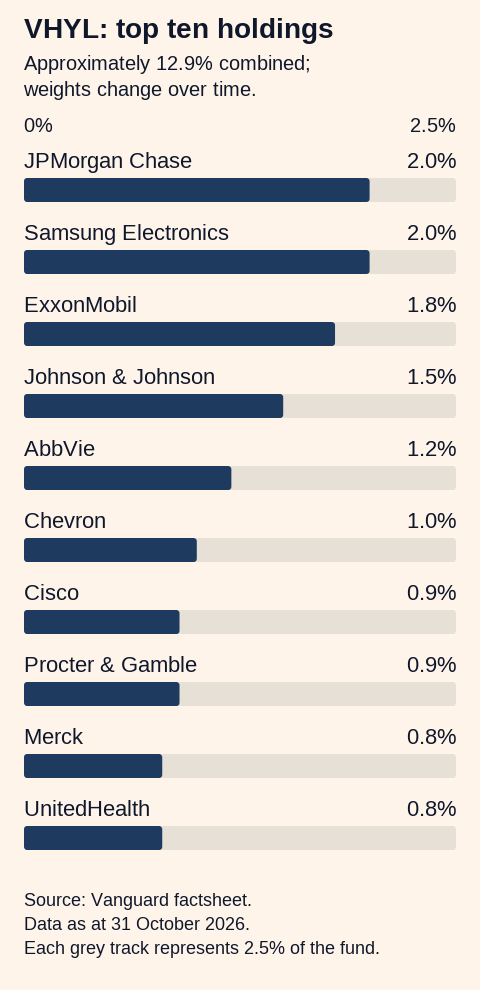 Diagram by Zero To Stocks. Rounded top-ten weights total approximately 12.9%. Source: Vanguard factsheet, data as at 31 October 2026.
Vanguard lists 2,432 stocks at that date. justETF lists 2,428 holdings at 30 September 2026 and a 12.40% top-ten total, with a different list at the bottom. These are separate snapshots. The VUKE review describes a UK fund whose top ten make up about half its holdings by weight.
Sectors
Vanguard's 31 October 2026 breakdown uses ICB, the Industry Classification Benchmark, a system for grouping companies by industry. Financials is the largest sector at 28.7%; Technology is 5.6%. The weights change.
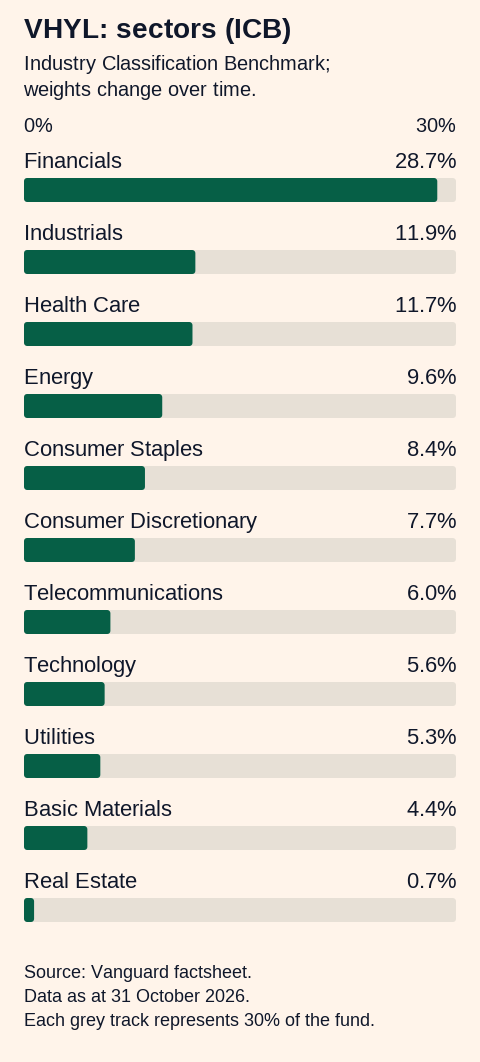 Diagram by Zero To Stocks. Vanguard's rounded ICB sector weights. Source: Vanguard factsheet, data as at 31 October 2026.
The index excludes REITs. Vanguard still lists a 0.7% Real Estate weight. The industry mix is part of the choice when comparing VHYL with a broader world fund.
Countries
The US is the largest market in Vanguard's allocation at 31 October 2026, at 40.5%; Japan is 9.0% and the UK 6.9%. These weights change.
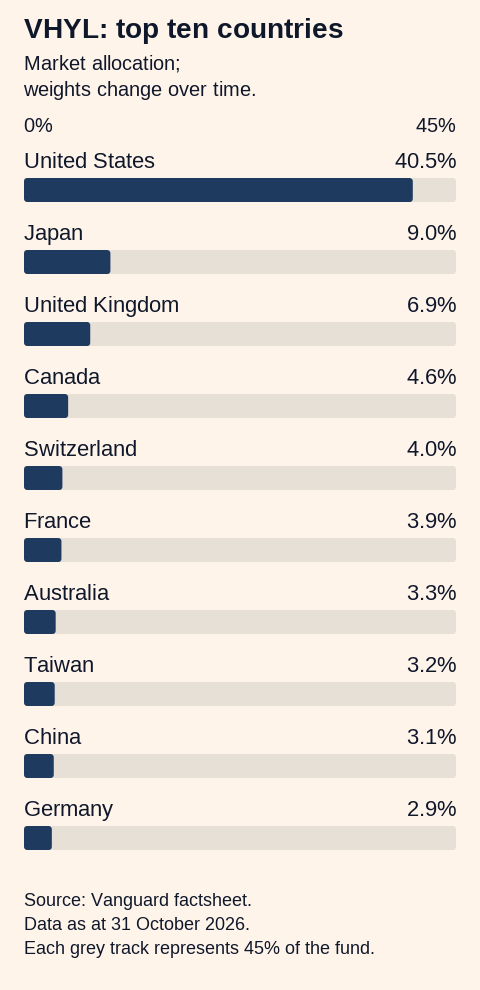 Diagram by Zero To Stocks. Top ten markets by rounded weight. Source: Vanguard factsheet, data as at 31 October 2026.
Our subtraction of the ten displayed weights from 100% leaves 21.6% across other countries. justETF reports 36.98% for the US at 30 September 2026. The sources use different dates and classifications, so do not combine their figures.
VHYL dividends: dates and amounts
Distributing means the fund pays dividends out. Vanguard's latest four listed payments are below, in US dollars per unit. The fund's base currency is USD, even though VHYL trades in pounds on the London exchange.
| Amount per unit | Ex-dividend date | Payable date |
|---|---|---|
| US$0.5191 | 17 September 2026 | 30 September 2026 |
| US$0.9263 | 18 June 2026 | 1 July 2026 |
| US$0.4290 | 19 March 2026 | 1 April 2026 |
| US$0.4600 | 18 December 2025 | 31 December 2025 |
The ex-dividend date is the date from which a purchase no longer carries entitlement to that payment. The payable date is when the fund pays it. What you receive in pounds depends on the exchange rate and your broker.
US$2.3344 per unit is our sum of the four payments Vanguard lists. In this period ex-dates fell in March, June, September and December. June was the largest payment in each displayed year: US$0.9263 in 2026 and US$0.8841 in 2025. Amounts and dates can change. Check Vanguard's distribution history for the next date.
VHYL vs VHYG
VHYL and VHYG are share classes of the same fund and follow the same index. Accumulating means dividends are retained and reinvested inside the fund.
| Detail | VHYL | VHYG |
|---|---|---|
| Dividend policy | Distributing quarterly | Accumulating |
| London GBP / USD ticker | VHYL / VHYD | VHYG / VHYA |
| ISIN | IE00B8GKDB10 | IE00BK5BR626 |
| Inception | 21 May 2013 | 24 September 2019 |
| TER, per justETF | 0.29% a year | 0.29% a year |
| Fund size, per justETF | EUR 10,373m | EUR 3,383m |
Both size figures are from justETF, checked November 20, 2026. Choose the dividend treatment that fits your cash needs; the stated charge is the same.
VHYL vs VWRL and VWRP
VWRL follows the broader FTSE All-World index. VHYL selects the higher-forecast-dividend part of that large and mid-sized company universe, with different sector weights.
| Detail | VHYL | VWRL |
|---|---|---|
| Selection | Higher forecast dividend yield | FTSE All-World |
| Holdings, per justETF | 2,428 at 30 September 2026 | 3,797 |
| TER | 0.29% | 0.14% |
| Dividends | Distributed quarterly | Distributed quarterly |
VWRP is the accumulating counterpart to VWRL. Our VWRP vs VUAG guide covers its world-market scope, while the VWCE review explains related tickers. The selection and cost differences do not tell you which will perform better.
Cost: 0.29% a year
Vanguard calls its yearly charge the OCF, or ongoing charges figure; justETF calls it the TER, or total expense ratio. Both describe a yearly fund running charge. See our TER guide for the detail.
On a constant £10,000 holding, 0.29% is approximately £29 a year for VHYL or VHYG. At VWRL's 0.14%, the same illustration is approximately £14. The charge comes from fund assets; the pound amount depends on the value held.
VHYL in an ISA and a GIA
An ISA, or Individual Savings Account, is a UK tax wrapper. GOV.UK says dividends inside it are not taxed. HMRC says offshore fund income and gains held through an ISA do not need to be declared. The total ISA subscription limit for 2026–27 is £20,000.
A GIA, or general investment account, is outside that wrapper. The dividend allowance is £500 a year: dividends within it are not taxed. Dividend income within any unused Personal Allowance is also not taxed. Above the allowances, GOV.UK lists these rates for 6 April 2026 to 5 April 2027:
| Income Tax band | Dividend rate |
|---|---|
| Basic | 10.75% |
| Higher | 35.75% |
| Additional | 39.35% |
justETF lists both share classes as UK Reporting. A reporting fund reports income for UK tax purposes. HMRC says your share of reportable income is taxable, including any amount above what was paid out. That difference is called excess reported income. VHYG can therefore have taxable reportable income in a GIA even when it pays you no cash.
A fund selecting for dividends could reach the £500 allowance sooner than a holding producing less dividend income; that is a possibility, not a prediction. GOV.UK lists a £3,000 annual exempt amount for Capital Gains Tax on gains, separate from the dividend allowance.
Risks
The industry mix has a large Financials weight and a smaller Technology weight. The US is the largest country exposure in Vanguard's dated snapshot. Exchange-rate changes can affect the investment; a pound trading line does not remove currency risk.
Vanguard also lists liquidity risk, when investments are hard to trade; counterparty risk, when another institution fails to meet its obligations; and index tracking risk, when the fund does not follow its index exactly. justETF says the fund uses securities lending: it lends shares to another party.
Dividends can fall or stop. A company that no longer meets the index's dividend rules is removed at a review under those rules. Investment values and income can fall, and you may get back less than you invested.
How to choose
- If you want quarterly cash, consider VHYL's distributing policy. If you want reinvestment inside the fund, consider VHYG.
- If you want the broader world-index universe, compare VWRL and VWRP with VHYL's dividend selection.
- Check your ISA position and allowance first, then consider the reporting-fund rules for a GIA.
- Check the ISIN, London exchange and GBP line, and the current holdings on Vanguard or justETF.
Our guide to starting with ETFs as a European investor explains the wider process.
Limits of this guide
This is general information, not investment or tax advice. UK tax figures cover 2026–27. Your circumstances affect what you owe. Vanguard portfolio figures are dated 31 October 2026 and the justETF composition figures 30 September 2026; they change. Past distributions do not predict future payments.
Sources checked November 20, 2026.
Sources
- S1: justETF — Vanguard FTSE All-World High Dividend Yield UCITS ETF Distributing, IE00B8GKDB10
- S2: Vanguard factsheet VHYL, 31 October 2026 (professional)
- S3: Vanguard UK professional product page VHYL (9506)
- S4: justETF — Vanguard FTSE All-World High Dividend Yield UCITS ETF Acc, IE00BK5BR626
- S5: FTSE Russell — FTSE All-World High Dividend Yield Index Ground Rules (v2.8, February 2026)
- S6: GOV.UK — Individual Savings Accounts
- S7: HMRC HS265 Offshore funds
- S8: GOV.UK — Capital Gains Tax allowances
- S9: GOV.UK — Tax on dividends
- S10: justETF — Vanguard FTSE All-World UCITS ETF (USD) Distributing (VWRL), IE00B3RBWM25
FAQ
What is VHYL?
VHYL is the London pound listing of Vanguard's distributing global high-dividend ETF, ISIN IE00B8GKDB10. It holds large and mid-sized companies and pays dividends quarterly.
How does VHYL choose its stocks?
Its index removes real estate investment trusts and companies without qualifying past or forecast dividends, then ranks eligible shares by forecast dividend yield. It reviews the selection in March and September.
When does VHYL pay dividends?
Vanguard lists quarterly payments. The four shown in this guide had ex-dividend dates in December 2025 and March, June and September 2026. Check Vanguard's distribution history for the next date.
What is the difference between VHYL and VHYG?
VHYL distributes dividends while VHYG reinvests them. They are share classes of the same fund; justETF lists a 0.29% yearly TER for each.
Is VHYL tax-free in an ISA?
GOV.UK says dividends in an ISA are not taxed. HMRC says offshore fund income and gains held through an ISA do not need to be declared. The total ISA subscription limit for 2026–27 is £20,000.
Continue reading